|
||

• wydawnictwa polskie
• Zamów informacje o nowościach z wybranego tematu • kontakt
• Cookies na stronie |
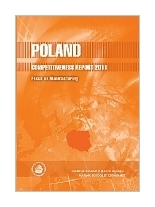
POLAND COMPETITIVENESS REPORT 2011WERESA M.A EDITORwydawnictwo: SGH , rok wydania 2011, wydanie Icena netto: This, the 26th edition of the annual report on the Polish economy published by the Warsaw School of Economics’ World Economy Research Institute, aims to provide a detailed assessment of Poland’s competitive performance in the world economy in 2010 seen from a comparative perspective. Competitiveness is defined here as a country’s ability to achieve a sustainable increase in the standard of living, along with an improvement in the country’s role in the global marketplace and its enhanced investment attractiveness. Within the framework of this definition, a set of indicators describing the effects and determinants of Poland’s competitiveness have been analyzed for the period of 2004-2010, and compared with those of other European Union countries, in particular the 10 new member states from Central and Eastern Europe (EU10). The cross-country comparison is conducted in both quantitative and qualitative terms, which makes it possible to forecast future trends and indicate some areas of policy priorities. The report is divided into three parts supplemented by concluding remarks and a statistical annex. Part One, which consists of two chapters, is aimed at interpreting the available evidence on trends in the nation’s prosperity and on Poland’s international economic position. Poland’s economic performance and growth trends are benchmarked against those of other countries and also against the EU average. Furthermore, real income convergence and existing income disparities have been analyzed and two scenarios are presented for bridging the existing income gap between Poland and EU15 countries. This assessment is followed by a study of Poland’s competitive position in external relations, with a special focus on the country’s advantages in foreign trade and its attractiveness in terms of foreign direct investment. The second part of the report (chapters 3 and 4) provides a detailed analysis of the determinants of Poland’s competitiveness. The framework for this assessment goes beyond a growth-accounting breakdown of economic performance. Factors that affect competitiveness are grouped into two broad categories: assets and institutions. The availability of resources (labor, capital, technology and innovation) and their productivity, as well as contextual factors (current economic policy, financial markets and the overall business environment) have been described quantitatively and qualitatively, and their importance to Poland’s competitive performance in 2010 has been evaluated. The third part of the report offers an in-depth analysis of the competitiveness of Poland’s manufacturing sector from both the international and domestic perspectives. At the center of this assessment is the growing role of innovation as a source of the long-term economic performance and competitive position of manufacturing. The capacity to transform knowledge into unique and high-value products, as well as the ability of Polish enterprises to develop cooperation in innovative activities, have been evaluated on the basis of relevant statistical data and questionnaire research. These three parts of this report are followed by concluding remarks about Poland’s possible paths of development, and economic priority choices that should enable Poland to enhance its competitiveness and reach the targets set in the European Union’s Europe 2020 strategy. 381 pages, Paperback Księgarnia nie działa. Nie odpowiadamy na pytania i nie realizujemy zamówien. Do odwolania !. |