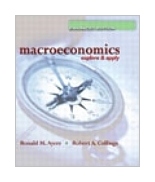
For two-semester courses in Principles of Economics. This easy to read, accessible,
macro-first principles text engages students with familiar real-world examples and
applications that bring economics to life. The authors follow an Explore & Apply theme
to show students how economics is a part of their everyday lives and how it can be a
useful tool in making personal decisions and evaluating policy decisions.
Features
- Concise, yet complete coverage, focuses on topics at the heart of economics. Exposes
students to early coverage of consumer and producer surplus, utility and consumer
decision, as well as government and market failure.
- Early coverage of the Aggregate Demand/Aggregate Supply model in Chapter 8. Allows
instructors the flexibility to decide which models are best suited for their students.
Provides students with a comprehensive discussion of AD and its shift factors, and both
long-run and short-run AS, and the macroeconomic equilibrium.
- An entire, self-contained chapter on the Keynesian Cross in chapter 10. Presents
students with the essential concepts of the income-expenditure model in an intuitive way
that avoids excessive mathematical detail.
- Early emphasis on Short Run. Introduces the output gap and inflationary/recessionary
gaps along with the appropriate fiscal policies to address them. Exposes students to
short-run adjustment processes, including cost-push inflation and the inflationary spiral.
Offers instructors flexibility in terms of the order in which the chapters are covered.
- Detailed and in-depth coverage of key economic concepts. Presents students with expanded
multiplier content, new material of crowding out, greater detail on exchange rates, and
more extensive treatment of antitrust, just to name a few.
- Detailed graphs with detailed labeling. Helps students to understand the shifts vs.
movements in curves, and makes these difficult concepts understandable.
- Current data, includes 2003. Reflects the most up-to-date information available.
- Additional, 5th test bank written by the authors for continuity with the text. Increases
the number of questions, adding to the already robust, preexisting test banks.
- Consistent Explore & Apply theme integrated throughout. Takes students on an
economic journey where they learn economic principles as they are exploring issues in
their world.
- 29 Explore & Apply sections address todays real-world, economic policy issues or
events in the final section of every chapter. Enables students to evaluate with reference
to the tools and concepts presented in the chapter, and examine both domestic and
international topics.
- Two Thinking Critically questions concludes each Explore & Apply section. Promotes
economic reasoning and encourage students to develop their critical thinking skills.
- Snapshots, highlight three brief applications of the concepts in each chapter. Allows
students to pause and consider the concepts they have just learned.
- QuickChecks . At least three brief questions with answers found throughout each chapter.
Gives students the chance to rapidly check and self-test their knowledge of a key concept
before moving on to the next section.
- Chapter-opening learning objectives. Lists 5 to 7 objectives that establish the goals
and organization of the chapter. Alerts students to key content to be covered in each
chapter, and helps them organize their study goals.
- Chapter-end summaries. Provides students with a helpful and coherent way to review
concepts.
- Accessible coverage, uses mathematics only where necessary. Enables students to focus on
intuition rather than technical detail.
Table of Contents
(NOTE: Each chapter contains sections titled A look Ahead, Chapter Summary, Key Terms,
Test Yourself, Questions and Problems, and Working with Graphs and Data.)
I. A JOURNEY THROUGH THE ECONOMY.
1. The Economic Perspective.
2. Production and Trade.
3. Demand and Supply.
4. The Power of Prices.
II. MONITORING THE MACRO ECONOMY.
5. Measuring National Output.
6. Unemployment.
7. Inflation.
III. AGGREGATE SUPPLY AND AGGREGATE DEMAND.
8. A Framework for Macroeconomic Analysis.
9. Fiscal Policy and Short-Run Instability.
10. Aggregate Expenditures.
IV. INCENTIVES FOR PRODUCTIVITY.
11. Fiscal Policy in Action.
12. Economic Growth.
V. MONEY AND MONETARY POLICY.
13. Money, Banking, and the Federal Reserve.
14. Monetary Policy and Price Stability.
VI. MICROECONOMIC FOUNDATIONS.
15. Elasticity: Measuring Responsiveness.
16. Consumer Behavior.
17. The Firm and Production.
18. Costs and Profit-Maximizing Output.
VII. OUTPUT MARKETS.
19. Pure Competition.
20. Monopoly and Antitrust.
21. Oligopoly and Monopolistic Competition.
VIII. INPUT MARKETS.
22. Markets for Labor and Other Inputs.
23. Earnings and Income Distribution.
IX. MARKET FAILURE AND GOVERNMENT ACTION.
24. Public Goods, Information, and Regulation.
25. Externalities and Common Property Resources.
26. Public Choice.
X. THE GLOBAL ECONOMY.
27. Into the International Marketplace.
28. Policy Toward Trade.
29. Economic Development.
494 pages
Księgarnia nie działa. Nie odpowiadamy na pytania i nie realizujemy zamówien. Do odwolania !.