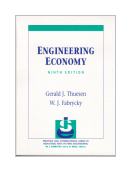
Engineering Economy, 9/e
Gerald J. Thuesen, Professor
Emeritus, Georgia Institue of Technology
W.J. Fabrycky, Lawrence Professor Emeritus, Virginia Polytechnic Institute
Published May, 2000 by Prentice Hall
Engineering/Science/Mathematics
Copyright 2001, 637 pp.
Cloth ISBN 0-13-028128-X
This book emphasizes the concepts and techniques of analysis that prove useful in
evaluating the economic feasibility of engineering systems, projects, and services for
decision purposes. It also familiarizes the engineer with operations and operational
feasibility necessary to considerations of the design process. KEY TOPICS: Chapter topics
cover economic and cost concepts; interest formula; calculations of economic equivalence;
equivalence involving inflation; bases for comparison and decision-making among
alternatives; evaluating production operations and replacement alternatives; accounting;
income taxes in economic analysis; decisions under risk and uncertainty and involving
multiple criteria; and estimating economic elements. For a basic understanding of
mathematical modeling in complex operational systems, essential to a growing number of
engineers today.
(NOTE: Most chapters conclude
with Key Points and Questions and/or Problems.)
I. INTRODUCTION TO
ENGINEERING ECONOMY.
1. Engineering and
Engineering Economy.
Engineering and Science. The
Bi-Environmental Nature of Engineering. Physical and Economic Efficiency. The Engineering
Process. Engineering for Economic Competitiveness. Engineering Economy and the Engineer.
2. Some Economic and Cost
Concepts.
Concepts of Value and
Utility. Consumer and Producer Goods. Economic Aspects of Exchange. Classifications of
Cost. Life-Cycle Cost. Interest and Interest Rate. The Time Value of Money. The Earning
Power of Money. The Purchasing Power of Money.
II. INTEREST FORMULAS AND
EQUIVALENCE.
3. Interest Formulas.
Simple and Compound Interest.
Describing Cash Flows over Time. Interest Formulas (Discrete Compounding, Discrete
Payments). Interest-Formula Relationships. Compounding Frequency Considerations. Interest
Formulas (Continuous Compounding, Discrete Payments). Summary of Interest Formulas.
- 4.
Calculations of Economic Equivalence.
Involving a Single Factor. Equivalence Calculations Involving Cash Flows. Principle of
Equivalence. Equivalence Calculations with More Frequent Compounding. Equivalence
Calculations Involving Bonds. Equivalence Calculations Involving Loans. Equivalence
Calculations Involving Working Capital.
5. Equivalence Involving Inflation.
Rate. Considering the Effects of Inflation. Analyzing Inflation in Investments.
III. ECONOMIC ANALYSIS OF
ALTERNATIVES.
6. Bases for Comparison of
Alternatives.
Present Worth. Annual
Equivalent. Future Worth. Internal Rate of Return. Payback Period. Capitalized Equivalent
Amount. Capital Recovery with Return. Project Balance.
- 7.
Decision Making among Alternatives.
Exclusive Alternatives. Elements of Decision Criteria. Present Worth on Incremental
Investment. IRR on Incremental Investment. Comparisons Based on Total Investment.
Comparing Alternatives with Unequal Lives.
8. Evaluating Production Operations.
Analysis. Operation and Production Decisions. Economic Operation of Equipment. Models for
Procurement Operations.
9. Evaluating Replacement Alternatives.
Replacement Alternatives. Replacement Analysis for Unequal Lives. The Economic Life of an
Asset. Replacement Assumptions and Decisions. Retirement or Abandonment Decisions.
Examples of Replacement Problems.
10 Evaluating Public Activities.
Activities. Financing Public Activities. Public Activities and Engineering Economy.
Benefit-Cost Analysis. Identifying Benefits, Disbenefits, and Costs. Cost-Effectiveness
Analysis.
-
>IV. ACCOUNTING,
DEPRECIATION, AND INCOME TAXES.
11. Accounting and
Depreciation Accounting.
General Accounting. Cost
Accounting. Depreciation. Accounting for the Depreciation of Capital Assets. Basic
Depreciation Methods. Modified Accelerated Cost Recovery System (MACRS).
Units-of-Production Depreciation. Depletion.
- 12.
Income Taxes in Economic Analysis.
for Corporations. Effective Income-Tax Rates. Interest and Income Taxes. Depreciation and
Income Taxes. Gain or Loss on Disposition of Depreciable Assets. Tax Credits. Depletion
and Income Taxes. Calculating After-Tax Cash Flows. Evaluation of Financing Methods Using
After-Tax Cash Flows. Capital Gains in After-Tax Cash Flows. Inflation and Its Effects on
After-Tax Flows. After-Tax Analysis of Replacements.
V. ESTIMATES, RISK, AND
UNCERTAINTY.
13. Estimating Economic
Elements.
The Elements to Be Estimated.
Cost Estimating Methods. Adjustment of Cost Data. Cost-Estimating Relationships.
Estimating and Allocating Indirect Costs. Accounting Data in Estimating. Judgment in
Estimating.
- 14.
Estimates and Decision Making.
for Uncertainty in Estimates. Considering a Rage of Estimates. Sensitivity Analysis.
15. Decisions Under Risk and Uncertainty.
Decision Making. Expectation Variance Decision Making. Monte Carlo Analysis. Decision
Trees in Decision Making. Decisions Under Uncertainty.
16. Decisions Involving Multiple Criteria.
Methods. Systematic Elimination Methods. Weighting Methods of Evaluation. Decision
Evaluation Display. Decision Evaluation Display Examples. Summary: Making the Decision.
Appendices.
Interest Rates Corresponding to Nominal Rate r.
Selected References.
Index.
Księgarnia nie działa. Nie odpowiadamy na pytania i nie realizujemy zamówien. Do odwolania !.