|
||

• wydawnictwa polskie
• Zamów informacje o nowościach z wybranego tematu • kontakt
• Cookies na stronie |
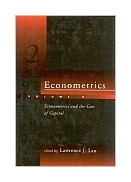
ECONOMETRICS VOL 2 ECONOMETRICS AND THE COST OF CAPITALLAU L.wydawnictwo: MIT PRESS , rok wydania 2000, wydanie Icena netto: ECONOMETRICS,VOL 2 Econometrics and the Cost of Capital "This volume provides a wonderful review of the interplay between economic theory and econometric modeling on many topics in applied economics, including firm investment behavior, consumer behavior, productivity measurement, and national income accounting. Each chapter captures both the excitement and the importance of applied economics, and will make profitable reading for economic researchers at all experience levels." James Poterba, Mitsui Professor of Economics, Massachusetts Institute of Technology Contents 1 Research on the Cost of Capital: Past, Present, and Future Lawrence J. Lau 1.1 Introduction 1.2 Historical Origin of the "Cost of Capital" 1.3 The Quest The Econometric Modeling of Intertemporal General Equilibrium 1.4 The First Decade (1963-1973) 1.5 The Second Decade (1973-1983) 1.6 The Third Decade (1983-1993) 1.7 Future Research Opportunities 1.8 Concluding Remarks 2 The International Consequences of the Leading Consumption Tax Proposals Robert E. Hall 2.1 Introduction 2.2 Taxes Considered 2.3 Basic Effects 2.4 Nominal Prices and Price Measurement 2.5 Effects of the Anticipation of Tax Reform 2.6 Interaction of the U.S. Economy and the Rest of the World 3 The Cost of Capital and RegulationLaurits R. Christensen 3.1 Introduction 3.2 Capital Costs for Unregulated and Regulated Firms 3.3 The Legacy of Improperly Measured Capital Costs for Regulated Electric Utilities in the United States 3.4 Incentive Regulation for U.S. Electric Utilities Based on the True Cost of Capital 3.5 Concluding Remarks 4 The Cost of Capital, Q, and the Theory of Investment Demand Fumio Hayashi 4.1 Introduction 4.2 The Cost of Capital 4.3 Detour: Corporate Taxes 4.4 Models with Strictly Convex Adjustment Costs 4.5 Multiple Capital Goods 4.6 Uncertainty 4.7 Irreversibility 4.8 Capital Structure 4.9 Conclusion Appendix 5 The Cost of Capital and the Measurement of Productivity Frank M. Gollop 5.1 Input Quality 5.2 Welfare versus Productivity Growth 5.3 Input Growth and Productivity Bias 5.4 Conclusion 6 The Jorgenson System of National Accounting Barbara M. Fraumeni 6.1 Introduction 6.2 National Accounting Systems 6.3 Definitional Tables 6.4 Human Capital and Nonmarket Accounts 6.5 Conclusion 7 Does Infrastructure Investment Increase the Productivity of Manufacturing Industry in the U.S.? Charles R. Hulten and Robert M. Schwab 7.1 Introduction 7.2 Testing the Alternative Models 7.3 Data 7.4 Econometric Results 7.5 Summary and Conclusions 8 The Cost of Capital and Consumer Behavior Thomas M. Stoker 8.1 Introduction 8.2 Modeling Demands with Flexible Functional Forms 8.3 Aggregate Demand and Heterogeneous Households 8.4 Related Innovations to Econometric Methods 8.5 A Closing Note 9 Innovations in Applied Welfare Economic Daniel T. Slesnick 9.1 Introduction 9.2 Welfare Economics at the Individual Level 9.3 Applications: The Measurement of Individual Welfare 9.4 Welfare Economics at the Aggregate Level 9.5 Applications: The Measurement of Social Welfare 9.6 Conclusions 10 The Cost of Capital and Intel-temporal General Equilibrium Modeling of Tax Policy Effect Kun-Young Yun 10.1 Introduction 10.2 The Cost of Capital 10.3 Intertemporal General Equilibrium Model 10.4 Welfare Analysis of Tax Policy 10.5 Concluding Remarks 11 Progress in Measuring the Price and Quantity of Capital W. Erwin Diewert and Denis A. Lawrence 11.1 Introduction 11.2 The Relationship between Asset Prices, Depreciation, and Rental Prices 11.3 The Declining Balance Depreciation Model 11.4 The Gross Capital Stock Model 11.5 The Straight Line Depreciation Model 11.6 Construction of the Alternative Reproducible Capital Stocks for Canada 11.7 Alternative Productivity Measures for Canada Using Declining Balance Depreciation 11.8 Alternative Productivity Measures for Canada Using Straight Line Depreciation 11.9 Alternative Productivity Measures for Canada Using One Hoss Shay Depreciation 11.10 Conclusion Data Appendix 12 Modeling Trade Policies and U.S. Growth: Some Methodological Issues Mun S. Ho 12.1 Introduction 12.2 Issues in Numerical Dynamic Models 12.3 The Structure of the Model 12.4 Effects of Trade Barriers 12.5 Conclusion Appendix A.I Household Sector A.2 Producer Sector A.3 Cost of Capital and Investor Behavior A.4 Government A.5 Rest-of-the-World A.6 The Markets and Equilibrium Conditions A.7 Solution of Model and Exogenous Variables A.8 Data and Parameters 13 The Cost of Capital and the Economics of the Environment Peter J. Wilcoxen 13.1 Introduction 13.2 The Econometric Approach 13.3 An Econometric General Equilibrium Model 13.4 Foreign Trade 13.5 Estimating the Effects of Environmental Regulation 13.6 Confidence Intervals 13.7 Conclusion 454 pages Księgarnia nie działa. Nie odpowiadamy na pytania i nie realizujemy zamówien. Do odwolania !. |