|
||

• wydawnictwa polskie
• Zamów informacje o nowościach z wybranego tematu • kontakt
• Cookies na stronie |
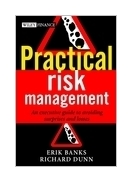
PRACTICAL RISK MANAGEMENT. AN EXECUTIVE GUIDE TO AVOIDING LOSSESBANKS E., DUNN Rwydawnictwo: WILEY , rok wydania 2003, wydanie Icena netto: Practical Risk Management: An Executive Guide to Avoiding Surprises and Losses is a concise, yet thorough, look at the world of financial risk management. The book is written by two senior banking professionals who have managed business and state- of-the-art financial risk in large and complex financial organisations, and who have also been in the middle of some of the most creative developments and turbulent times that the financial markets have ever seen. The book leverages these real experiences to offer useful and practical approaches to managing financial risk. It explores the challenges of risk management and how these can be overcome by focusing on governance and accountability within the framework of a clearly defined appetite for potential losses. Readers will gain a good understanding of the different financial risks, the various measurement tools currently available, and will learn to construct a practical risk process that is consistent with corporate strategy. Great emphasis is placed on the shortcomings of such a process and the need to learn from historical failures. Through this work, Banks and Dunn hope to stimulate ideas and provide a basis for further dialogue on effective financial risk management. The risk management lessons and experience which the two authors share in the book is relevant for a broad range of participants from Board members, CEOs, CFOs, senior management, regulators, auditors, financial analysts, academics and shareholders of large, medium size and small financial institutions, investment funds, smaller companies and non-financial organisations. As financial risks have no boundaries, Practical Risk Management will also appeal to executives around the world. The book, written in a clear, fast-paced and easily-digestible style, is an invaluable resource for all those who want to learn from, and avoid the repetitions of, the frequent financial disasters that abound without getting caught up in jargon, impractical theory, mathematics and formulae. ERIK BANKS has held senior risk management positions at several global financial institutions, including XL Capital, where he was Partner and Chief Risk Officer of the Bermuda reinsurer's derivative subsidiary, and Merrill Lynch, where he spent 13 years managing credit and market risk teams in Tokyo, Hong Kong, London and New York. Mr. Banks, an Adjunct Professor of Finance at the University of Connecticut, has written a dozen books on risk management, emerging markets, derivatives, merchant banking, and electronic finance. RICHARD DUNN became the youngest member of Merill Lynch's Executive Committee in 1998. Concurrent with this appointment, he was made Head of Market and Credit Risk and was instrumental in the Wall Street "bail out" of hedge fund LTCM. Prior to this, Mr. Dunn was Co-Head of Merrill's Equity Division, Head of European Debt, and Head of Asian Debt and Equity. His training was in debt and equity derivatives. Mr. Dunn holds a Masters in Economics from the London School of Economics, speaks Japanese, French and Italian, and is an avid snowboarder. Table of Contents Acknowledgments. Biographies. Introduction: Financial Risks and Avalanches. PART I DEFINING AND MEASURING RISKS. 1 Losses: One-Hundred-Year Floods that Happen Every Three Years. 2 The Basics: A Common Understanding of the Risks. 3 Liquidity: The Heart of the Matter. 4 Suitability: Coping with Customers. 5 Process Risks: The Next Frontier. 6 Measurement: Quantifying the Risks. PART II DEVELOPING A HOLISTIC APPROACH TO RISK MANAGEMENT. 7 The Risk Management Process: Building the Foundation. 8 The Financial Risk Mandate: Developing a Philosophy and Loss Tolerance. 9 Risk Principles: Creating a Code of Conduct. 10 Financial Governance: Assigning Accountability for Risk. 11 The Risk Framework: Limiting and Controlling Risks. 12 Automated Management: Automating Discipline on the Front Lines. 13 Manual Management: Enhancing the Automated Discipline. 14 Nuts and Bolts: Supporting the Process with Essential Tools. 15 Ongoing Diagnostics and Transparency: Knowing if the Risk Process is Working. Conclusion: Can there be Heroes? Glossary. References. Index. 176 pages Księgarnia nie działa. Nie odpowiadamy na pytania i nie realizujemy zamówien. Do odwolania !. |