|
||

• wydawnictwa polskie
• Zamów informacje o nowościach z wybranego tematu • kontakt
• Cookies na stronie |
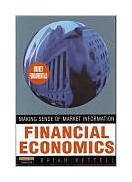
FINANCIAL ECONOMICS. MAKING SENSE OF MARKET INFORMATIONKETTELL B.wydawnictwo: PH , rok wydania 2001, wydanie Icena netto: The announcement that the Nobel Prize for Economics had been awarded to Merton Miller, "William Sharpe and Harry Markowitz, in 1990, finally acknowledges that financial economics is a genuine science, in the same league as the physical sciences. Defining what is financial economics is not straightforward as it is a subject which overlaps with both economics, finance and also with statistics. However, for the purposes of this book, we will use the term to refer to those aspects of economics, finance and investment management which involve the study of financial markets. More precisely, we will be using the term financial economics to mean a subject which concerns itself with the building of models of asset price determination for investors seeking to build portfolios in a world of uncertainty. Finance itself, as a subject for serious academic study in its own right, is relatively new, having grown out of applied economics over the past 50 years or so. Financial economics is even more recent. Notwithstanding its short life, the empirical research and theoretical developments in financial economics have been immense, with the USA dominating the subject for most of the period. The last 20 years have seen a revolution in the way financial economists understand the world around us. It was once thought that stock market and bond market returns were essentially unpredictable. Now it is recognized that stock and bond market returns have a substantial predictable component at long horizons. It was once thought that the capital asset pricing model (CAPM) provided a good description of why average returns on some stocks, portfolios, funds or strategies were higher than others. Now it is recognized that the average returns of many investment opportunities cannot be explained by the CAPM, and so-called 'multifactor models' have supplanted the CAPM to explain them. It was once thought that long-term interest rates reflected expectations of future short-term rates and that interest rate differentials across countries reflected expectations of exchange-rate depreciation. Now we can see what are known as time-varying risk premiums in bond and foreign exchange markets as well as in stock markets. The build up to these ideas are developed throughout the text providing a comprehensive review of all the key issues in this exciting new subject: financial economics. 508 STR. ISBN 0-273-63073-3 Księgarnia nie działa. Nie odpowiadamy na pytania i nie realizujemy zamówien. Do odwolania !. |