|
||

• wydawnictwa polskie
• Zamów informacje o nowościach z wybranego tematu • kontakt
• Cookies na stronie |
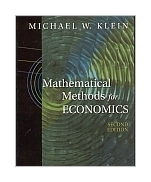
MATHEMATICAL METHODS FOR ECONOMICSKLEIN M.wydawnictwo: AW , rok wydania 2001, wydanie IIcena netto: Mathematical Methods for Economics Brief Description How does your level of education affect your lifetime earnings profile? Will economic development lead to increased environmental degradation? How does the participation of women in the labor force differ across countries? How do college scholarship rules affect savings? Students come to economics wanting answers to questions like these. While these questions span different disciplines within economics, the methods used to address them draw on a common set of mathematical tools and techniques. The second edition of Mathematical Methods for Economics continues the tradition of the first edition by successfully teaching these tools and techniques through presenting them in conjunction with interesting and engaging economic applications. In fact, each of the questions posed above is the subject of an application in Mathematical Methods for Economics. The applications in the text provide students with an understanding of the use of mathematics in economics, an understanding that is difficult for students to grasp without numerous explicit examples. The applications also motivate the study of the material, develop mathematical comprehension and hone economic intuition. Mathematical Methods for Economics presents you with an opportunity to offer each economics major a resource that will enhance his or her education by providing tools that will open doors to understanding. Features
Contents I. INTRODUCTION. 580 pages Księgarnia nie działa. Nie odpowiadamy na pytania i nie realizujemy zamówien. Do odwolania !. |