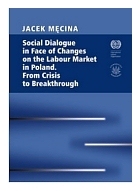
Social Dialogue in Face of Changes on the Labour Market in Poland
From Crisis to Breakthrough
Poland has been building its market economy for slightly
more than a quarter of a century and has been a member of the European Union for thirteen
years. Currently, Poland can feel the results of the international crisis, but with some
delay compared to the other European countries. Despite its stable economic development
and relatively low unemployment, a deterioration in the quality of labour relations is
noticeable, and what is more Poland recorded a rapid increase in such forms of atypical
employment and fixed-term employment, reaching the highest levels among the EU countries.
The result of the crisis in Poland was accompanied by the crisis of social dialogue
institutions. In effect of this crisis the new Social Dialogue Council was created with
the aim to enable tripartite dialogue in view of new challenges. The International Labour
Organization came as an inspiration for many countries and the ILO Decent Work Agenda
became a point of reference for the crisis. New challenges of social and economic
development require sound public management with participation of social partners, trade
unions and employers’ organisations.
Jacek P. Męcina
The reviewed book addresses a very wide range of problems related to labour
relations and the labour market in Poland, presenting the experience of social dialogue in
these areas as methods of solving such problems in everyday and crisis conditions. The
publication is a comprehensive elaboration of labour law and labour market issues, taking
into account the role of social dialogue, which should comply with the legal regulations
of the ILO and the EU, and finally Polish legislation to be an important element of public
policy management. In addition to interesting theoretical considerations, professor J.
Męcina undertakes a number of practical issues, easily moving from institutional issues
to public management. An advantage of this work is the presentation of statistical
summaries and review of legislation in a broader international and the European context.
This allows us to understand the distance that Poland has travelled since 1989, with
opportunities, but also threats, which social dialogue allows to mitigate.
Prof. dr hab. Marek Pliszkiewicz
Introduction
Chapter I
Social Dialogue and Challenges in the Area of Labour Market and Labour Relations -
Experience and Challenges for Poland
1.1. Social Dialogue and Labour Relations in Poland - Introduction
1.2. The Shaping of the Idea of Social Dialogue in Poland
1.3. Institutionalisation of Social Dialogue in Poland - from Liberal Solutions to
Characteristics of Neo-Corporationalism
1 4. Legal Frames for the Functioning of Social Dialogue
1.5. Social Dialogue and Social Agreements and Pacts
1.6. Social Dialogue Partners in Poland
Chapter II
Social Dialogue at the EU Level and the Development Priorities of Poland
2.1. Evolution and Development of Social Dialogue in the EU
2.2. The European Social Model - an Attempted Definition of the Term and an Analysis of
its Evolution in the EU
2.3. EU Development Strategies and the Perspective for Employment Growth
2.4. Flexicurity as a European Model of Security and Flexibility in the Labour Market
2.5. The Youth Guarantees as an EU Joint Initiative and Response to the Effects of the
Labour Market Crisis
Chapter III
Labour Market and Labour Relations in Poland - Socio-Economic Transformation and
Ten Years of European Integration
3.1. Labour Market and Unemployment
3.2. Structural Changes of Economy in Relation to Labour Relations
3.3. Influence of Post-Accession Emigration on Polish Labour Market
3.4. Costs of Labour and Wages and Labour Relations
3.5. Flexible Forms of Employment and Labour Relations
3.6. Development of Law and Labour Relations
3.7. Influence of Social Dialogue on Regulating Labour Relations
Chapter IV
Non-standard Forms of Employment in Poland in Light of Labour Law and the Labour
Market
4.1. Non-Standard Forms of Employment and the Labour Law System
4.2. The Scope of Labour Market Flexibility and Non-Standard Forms of Employment
4.3. Directions and Scope of Labour Market Deregulation
4.4. Deregulation, Flexibility, Atypical Employment Arrangements and Non-Standard Forms of
Employment
4.5. Work with an Employment Contract - Atypical Employment Arrangements
4.6. Non-Standard Forms of Employment
4.7. Non-Standard Forms of Employment in the Polish Labour Market
4.8. Instances of Non-Standard Forms of Employment on the Labour Market and the Labour Law
System - Conclusions de lege lata and de lege ferenda
Chapter V
The New Labour Market Policy - the Reform of the Public Employment Services and
the Youth Guarantee Plan
5.1. The Staff and Organizational Potential of Public Employment Services and the Problems
of Vocational Activation of the Unemployed
5.2. Collaboration with Employment Agencies
5.3. Limiting Long-Term Unemployment
5.4. Increasing Employment Ratę in Priority Groups
5.5. The Role of Employment Offices as Employment Agents
5.6. Improving the Effectiveness of the Public Employment Services
5.7. The National Training Fund
5.8. The Situation of Young People on the European Labour Markets and the Youth Guarantee
5.9. New Instruments Available for Young People
5.10. The Use of Available Instruments in the First Year of Youth Guarantee Plan
Implementation
CHAPTER VI
The Most Pressing Problems in Employment and the Polish Labour Market, and the
Possibility of a New Framework for Social Dialogue in Poland
6.1. Employment Law and the Issue of Work Without an Employment Contract (Non-Standard
Forms of Employment)
6.2. The Increase in Minimum Wage
6.3. Controversy Surrounding the Raise in the Retirement Age
6.4. Demands for lmproving the Labour Market
6.5. Raising of Social Benefits and a Fight Against Poverty Programme
6.6. Initiatives for Reconstruction of Effective Mechanisms of Social Dialogue
6.7. Return to the Tripartite Dialogue and Initial Experiences of the New Formuła of the
Social Dialogue Council
Summary
List of Abbreviations, Acronyms, Initials, and Symbols
List of Figures, Tables, Maps
420 pages, Hardcover
Księgarnia nie działa. Nie odpowiadamy na pytania i nie realizujemy zamówien. Do odwolania !.